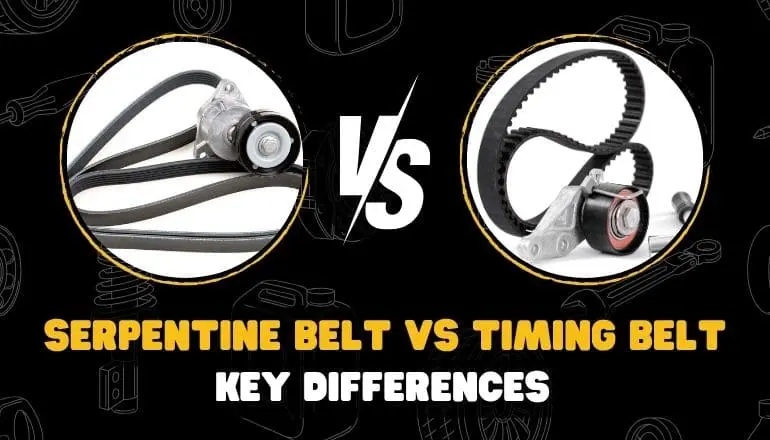
These days, understanding the serpentine belt vs timing belt difference is actually pretty important if you want to take proper care of your car. A lot of people think they’re kind of the same thing because of the names, but honestly, they do very different jobs inside the vehicle.
If you’re asking yourself, “Is a serpentine belt the same as a timing belt?” — the simple answer is no, not at all. Knowing how each one works, the warning signs, and even the replacement cost can really help you avoid serious engine trouble (and save a lot of money too).
Serpentine Belt vs Timing Belt – What’s the Main Difference
The distinction that needs to be made in between a serpentine belt and a timing belt lies in their respective uses.
The serpentine belt is used to transfer power from the engine, making sure that things like the alternator, air conditioner, power steering, and others work perfectly well.
A timing belt makes sure that the functioning of certain components, like the crankshaft and camshaft, goes well through synchronization.
Nevertheless, while both belts are equally important, the methods for their application differ significantly.
Serpentine and Timing Belts – Where Are They Located In Car?
Not really. The serpentine belt is a lengthy belt that is mainly found outside the engine. In addition, it is utilized to operate multiple aspects at the same time as well.
The timing belt, on the other hand, is buried inside the engine. It mainly functions silently to ensure that everything moves in the proper manner.
To make things simple:
The timing belt is internal, and it governs engine timing.
The serpentine belt serves as an external power source for accessories.
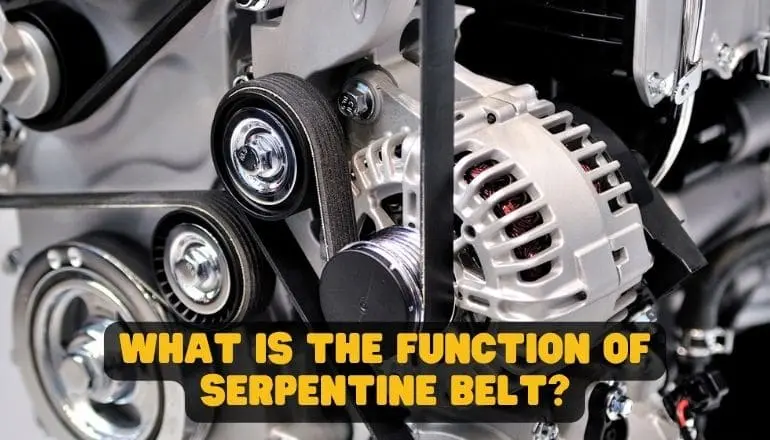
What Is the Function of the Serpentine Belt?
The role played by the serpentine belt is significantly important in assuring that everything within the car functions in a proper manner. Once the belt stops functioning, different problems will emerge right away.
Components powered by the serpentine belt:
The alternator (which charges the battery)
Power steering pump (makes steering easier)
Air conditioning compressor (keeps the car cool)
Water pump (some models aid engine cooling)
In recent times, most cars have only one belt (called serpentine) to replace all belts because of increased efficiency and energy savings. The downside is that when this one belt breaks down, it affects many other functions.
Signs of a Failing Serpentine Belt
A worn-out serpentine belt may cause some problems that are fairly easy to identify if you just pay some attention. In some cases, people tend to neglect some of these symptoms, which may then become serious down the road.
The symptoms include the following:
1. Squealing: You will hear squeals at an extremely high frequency in your engine bay right after starting your car.
2. Strained power steering: The power steering might be tough to maneuver when driving the car.
3. Engine overheats: In some models of cars, the serpentine belt assist run the water pump as well. Consequently, an unsuccessful belt will lead to overheating as well.
4. Wear along with tear: You can determine that there is wear and tear in the belt since it is showing visible signs, such as cracking.
5. Burning rubber smell: There might be a bad burning smell coming from the engine due to the friction.
6. Battery indicator light: This is a significant symptom that indicates the alternator is struggling to keep the battery charged.
Inspections will definitely be beneficial. It is recommended to get your belt checked because this is usually done in garages as part of routine maintenance.
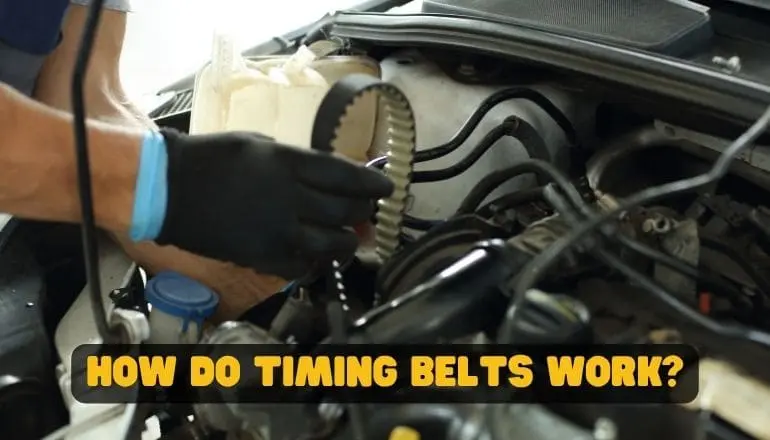
How Do Timing Belts Work?
The timing belt, like many elements within a car, functions behind the scenes yet is important to the operation of the car. It functions as a connection between the crankshaft and the camshaft.
In essence, this component regulates when engine valves are opened and closed as part of the combustion process. The problem is that if the timing isn’t perfect, your car engine will cease working.
Signs of a Faulty Timing Belt
Being capable of determining the signs of bad timing belt bad timing belt might assist you in avoiding expensive engine repairs.
Certain signs that should prompt your immediate attention include:
1. Ticking sound coming from the engine: It is one of the first warning signs of a problem.
2. “Check engine” warning: It does not necessarily mean a faulty timing belt.
3. The car does not start or stops suddenly: These problems indicate a failing or failed timing belt.
4. Misfiring engine: It can make the engine malfunction.
5. Oil dripping from the front part of the engine: Oil may drip due to worn-out seals on the timing belt.
Avoiding these warnings might prove hazardous, since a broken timing belt might result in total engine damage, and at this point, the repair procedure might be expensive indeed.
Cost Comparison: Serpentine Belt versus Timing Belt
It is always effective to know roughly how much the replacement will cost before facing a problem.
Cost To Replace Timing Belt:
Timing belt replacement cost Perth usually falls within the range of $500 to $1500 (or even higher, based on the car).
The cost differs based on the car, along with engine specifications.
Sometimes involves the water pump being replaced at the same time, which increases the total cost.
However, changing the timing belt can be tricky, and thus, it is recommended to do it professionally.
Serpentine Belt Replacement Cost:
It is comparatively less expensive that can cost you around $100-$300.
Serpentine belts are relatively easy to reach and change, so labor charges will be less.
How Frequently Should You Change These Belts?
Getting these belts changed regularly will keep you away from any unexpected breakage or expensive repairs. Putting it off initially does not seem to be an issue, but later, it can prove to be a much bigger problem for you.
Serpentine Belt:
It needs changing after 60,000 to 100,000 km.
You must check at regular services.
Timing Belt:
It need to be changed after 70,000 to 100,000 km.
Following the guidelines provided by the manufacturer is important, as they may differ.
Key Takeaways
Timing belts govern the internal engine timing.
Serpentine belts drive external accessories.
Both are necessary for vehicle performance.
Serpentine belts drive external accessories.
Failure of either belt might result in major consequences.
Understanding the difference between serpentine belt and timing belt allows you to properly manage your automobile and avoid costly repairs.
Choosing the Right Mechanics In Perth
Whether it’s a simple belt repair or a complete timing belt service in Perth, selecting the appropriate personnel is critical. Thus, you must search for:
Expert mechanics in Perth, such as SAI Auto Care, provide dependable car repair services. We provide complete general and major car service Perth, vehicle inspection for all makes and models. Contact us to schedule an appointment now!
A serpentine belt and a timing belt are both vital components for keeping your vehicle functioning at its best. The serpentine belt is also referred to as the poly belt, multi-belt, or accessory drive belt.
The serpentine belt drives other aspects inside the car, involving the alternator and air conditioning. Still, the timing belt ensures that all engine elements move in sync.
If you overlook the initial warning symptoms of your vehicle or fail to undertake regular maintenance services, there may be extensive damage that occurs, which will require costly repair. Thus, inspections need to be carried out regularly, as they may prevent any serious issues from developing.
FAQ’s
1) How to tell if a timing belt or serpentine belt is bad?
Answer 1:
Visible wear, strange sounds, and engine difficulties, along with warning lights, all indicate concern. Thus, a useful diagnosis needs an expert examination.
2) How often should I replace a serpentine belt?
Answer 2:
Changing a serpentine belt is needed after every 60,000-100,000 kilometers, based on the car’s conditions of use.
3) What is the life expectancy of a serpentine belt?
Answer 3:
Serpentine belts have a lifespan of about 60,000-100,000 kilometers, although yearly inspections can easily determine damage at an earlier stage as well.
4) Is there any warning before a timing belt breaks?
Answer 4:
You often get warning signs when the engine oil leaks out or there is trouble getting the engine started. But unfortunately, there aren’t any early signs of a bad timing belt; it can break without giving any warning.
Get a Quote
Appointments
Direction
Contact Us
Please hold while we redirect you to our booking engine.Book Now